
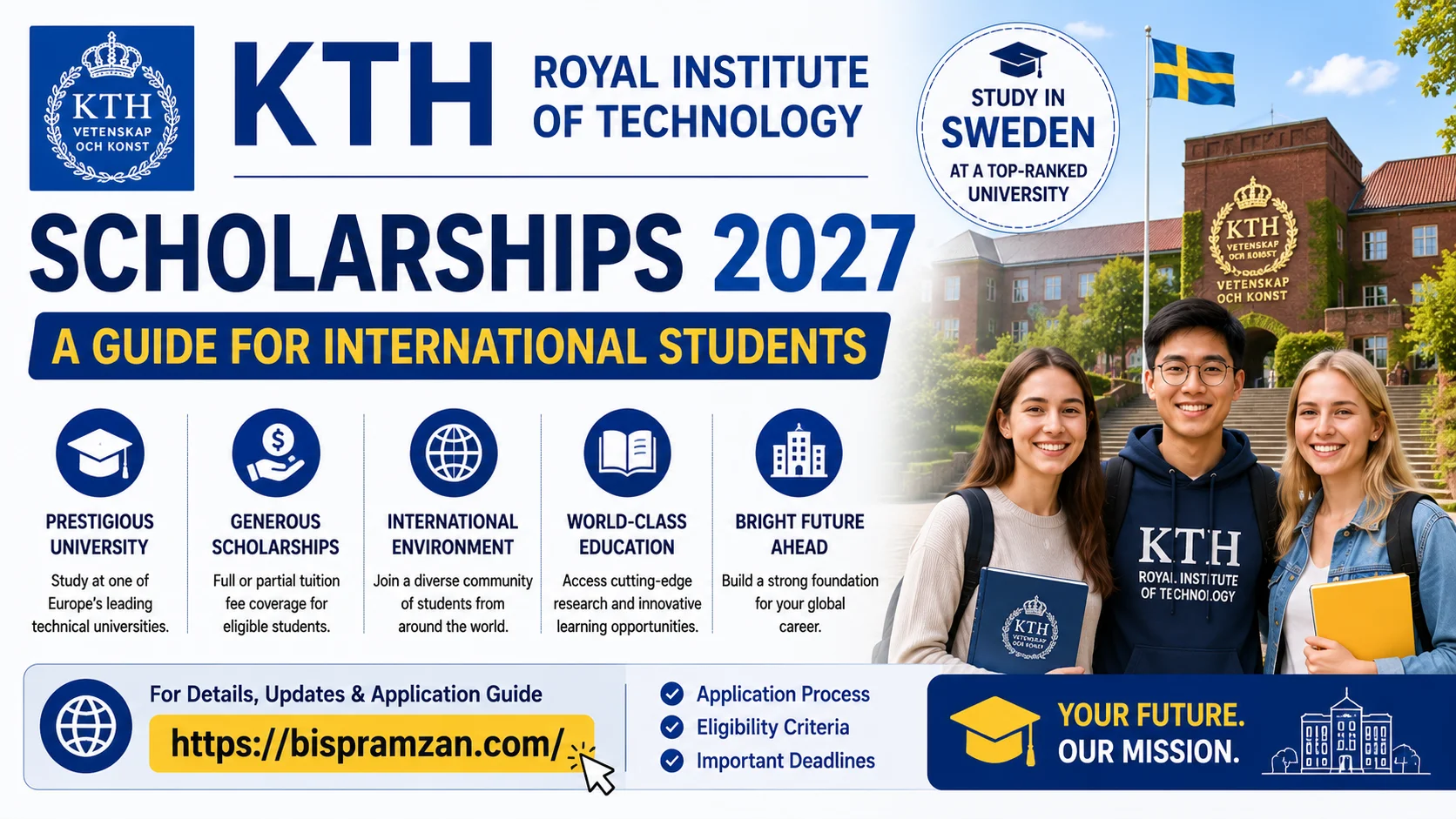
KTH Royal Institute of Technology Scholarships 2027: A Guide for International Students
KTH Royal Institute of Technology Scholarships 2027: Choosing where to study abroad often comes down to one practical question: can you actually afford it? For students eyeing KTH Royal Institute of Technology in Stockholm — one of Europe’s leading technical universities — the answer largely depends on Sweden’s scholarship system. This guide walks through what studying at KTH actually costs, how the university’s scholarships work, and what it takes to be a competitive applicant for the 2027 intake.
Read More: METI Japan Internship Program 2026: A Fully Funded Government of Japan Opportunity
Why International Students Look at KTH
KTH is Sweden’s oldest and largest technical university, offering close to 60 English-taught master’s programmes in fields ranging from engineering and computer science to architecture and sustainable technology. It placed 82nd in the 2027 QS World University Rankings, reflecting a strong international research reputation. For students building a career in engineering or technology, a KTH degree carries real weight on a résumé — but for anyone outside the EU/EEA or Switzerland, that degree also comes with a tuition bill that scholarships are designed to soften.
Understanding the Cost Before the Scholarship
It helps to know what you’re actually being scholarshiped against. Most two-year master’s programmes at KTH carry a tuition fee of roughly SEK 360,000 for non-EU/EEA/Swiss citizens — split across two academic years. EU/EEA and Swiss citizens, by contrast, pay no tuition at all. This gap is exactly why KTH’s scholarship system matters so much to prospective international applicants, and why understanding your eligibility early can shape which programmes you realistically consider.
The Scholarship Landscape at KTH
Rather than a single blanket scholarship, KTH runs several distinct award tracks, each with its own target group and rules.
The KTH Scholarship is the university’s main award, and the one most applicants are aiming for. It covers the full tuition fee for your first year, and extends into the second year as long as your academic performance stays satisfactory. It’s merit-based, factoring in both academic strength and a demonstrated interest in sustainable development. It’s also highly competitive — in a recent intake, only about 8% of admitted scholarship applicants actually received the award, which gives a realistic sense of how selective this process is.
The KTH India Scholarship exists specifically for Indian citizens who completed their undergraduate studies in India. It follows a similar first-priority, fee-paying-student framework as the general KTH Scholarship but is a separate track with its own eligibility rules.
The KTH Joint Programme Scholarship fills a gap for applicants to certain joint master’s programmes that don’t qualify for the standard KTH Scholarship — so if your target programme is a joint degree, it’s worth checking whether this track applies instead.
Beyond KTH’s own scholarships, external funding is also worth exploring — particularly Swedish Institute (SI) Scholarships, which cover both tuition and living costs for students from specific eligible countries, and the Fulbright U.S. Student Program for American applicants. These aren’t administered by KTH directly, but they can be combined with — or serve as an alternative to — a KTH-specific award.
Who Actually Qualifies
Scholarship eligibility at KTH isn’t just about being a good student — there are structural requirements that determine whether you’re even in the running:
- You need to be a fee-paying student, which generally means a non-EU/EEA/Swiss citizen.
- Your chosen KTH master’s programme must be listed as your first priority on your application — scholarships aren’t awarded to programmes ranked second, third, or fourth.
- You must have paid the application fee by the deadline.
- Not every programme is eligible for every scholarship. Joint Erasmus+ and EIT programmes, for instance, are excluded from the standard KTH Scholarship, along with the joint programme in Computer Simulations for Science and Engineering — though some of these applicants may instead qualify for the KTH Joint Programme Scholarship.
This is worth double-checking before you finalize your programme choices: picking your dream programme as a second choice, even for strategic reasons, can quietly disqualify you from scholarship consideration entirely.
Building a Timeline for 2027
Scholarship nomination at KTH isn’t a separate application — it happens automatically as part of your master’s programme application, which makes the admissions calendar the only calendar that matters. For the August 2027 intake, the general pattern looks like this:
- October 2026 — Master’s applications open
- 15 January 2027 — Application and scholarship consideration deadline
- Late January 2027 — Application fee payment deadline
- Late March 2027 — Scholarship results announced
- August 2027 — Programme begins
Because there’s no separate scholarship form, missing the January application deadline means missing scholarship consideration too — there’s no second chance to apply for funding after the fact. Some joint programmes run on different deadlines, so it’s worth confirming the specific date for your programme rather than assuming the general timeline applies.
What Actually Makes an Application Competitive
Since KTH Scholarship selection comes down to academic merit and sustainability engagement, a few things genuinely move the needle:
- A strong, well-documented academic record. Transcripts and grades carry real weight given how merit-based the selection process is.
- A motivation letter that reflects genuine engagement with sustainability, since KTH explicitly factors this into scholarship decisions — vague statements about “wanting to help the environment” carry less weight than specific projects, coursework, or experience.
- Correct prioritization. Make sure your target programme is genuinely your first choice on the application, not just something you’re considering.
- Early preparation. Since transcripts, recommendation letters, and other documents can take weeks to assemble, starting well before the October opening keeps you from rushing before January.
A Realistic Way to Approach Your Application for KTH Royal Institute of Technology Scholarships 2027
Given how selective the KTH Scholarship is, it’s worth building a funding strategy rather than relying on a single award. That could mean:
- Applying for the KTH Scholarship as your primary target if you meet the eligibility criteria.
- Checking whether the KTH India Scholarship or KTH Joint Programme Scholarship applies to your specific situation.
- Exploring external scholarships like the Swedish Institute awards or Fulbright in parallel, rather than waiting to see if you’re awarded a KTH scholarship first.
- Budgeting for the possibility that you may need to partially self-fund, especially for the second year if your first-year grades fall short of the scholarship’s continuation requirements.
Frequently Asked Questions
Is there a separate application for KTH Royal Institute of Technology Scholarships 2027? No. For most KTH scholarships, nomination happens automatically through your master’s programme application — there’s no additional form to fill out separately.
What if my first-priority programme changes after I apply for KTH Royal Institute of Technology Scholarships 2027? Scholarship eligibility is tied to your programme being listed as first priority at the time of assessment, so changing your ranking after the fact could affect your eligibility. It’s best to be certain about your first choice before submitting.
Do scholarships cover living costs? KTH’s own scholarships typically cover tuition only, not housing, food, or other living expenses. For living cost support, external scholarships like those from the Swedish Institute are a better fit.
Are EU/EEA students eligible for these scholarships? Not really relevant to them — EU/EEA and Swiss citizens don’t pay tuition at KTH Royal Institute of Technology Scholarships 2027 in the first place, so these scholarships are aimed at non-EU/EEA/Swiss applicants who would otherwise be paying full fees.
What happens if I don’t get the KTH Royal Institute of Technology Scholarships 2027? You can still enroll as a fee-paying student if admitted, and you remain eligible to explore external funding options such as SI Scholarships or country-specific government funding, depending on your nationality.
Final Thoughts About KTH Royal Institute of Technology Scholarships 2027
A KTH Royal Institute of Technology Scholarships 2027 can turn an otherwise expensive master’s degree into a genuinely affordable one, but the process rewards early, careful preparation rather than a last-minute application. Understand which scholarship track actually applies to your situation, make sure your target programme is your true first choice, and treat the January deadline as fixed and non-negotiable. For the latest figures, deadlines, and programme-specific exclusions, always check KTH’s official scholarships page directly, since details can shift from one admissions cycle to the next.